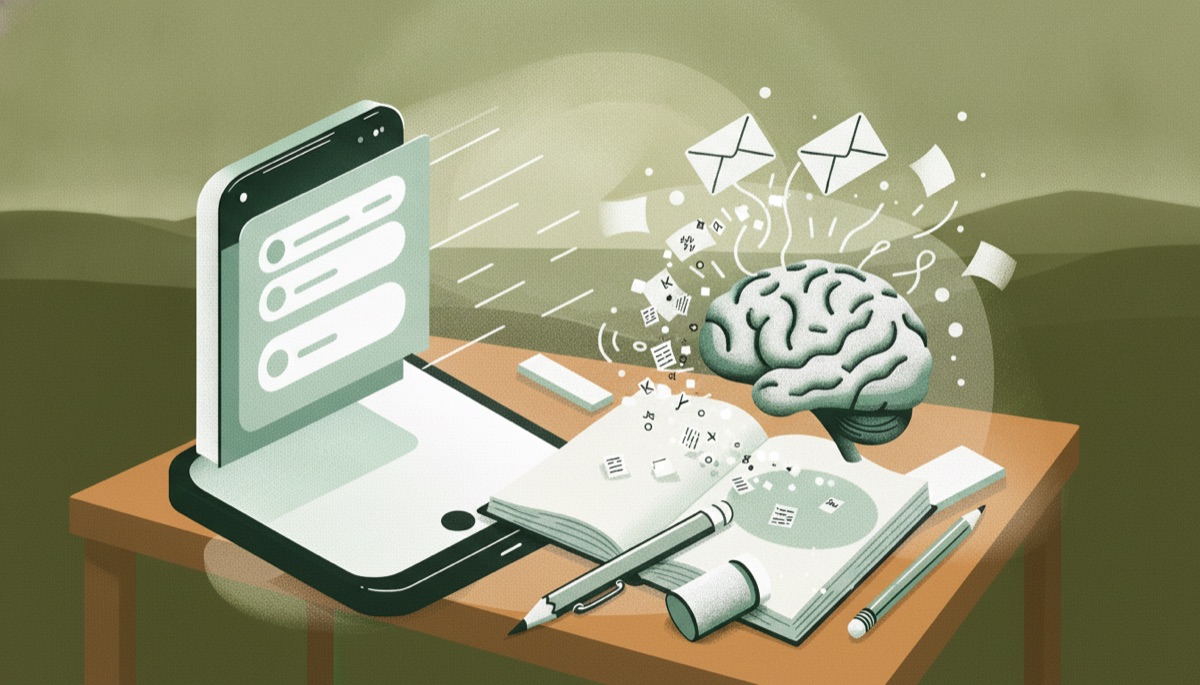
Your brain is not a storage device. It's a processor. And right now, you're trying to use it as both.
That's why you feel overwhelmed. Not because you have too much to do, but because you're trying to remember all of it while also doing it.
A brain dump fixes this. Fast.
What Is a Brain Dump?
A brain dump is exactly what it sounds like. You take every thought, task, worry, idea, and obligation floating around in your head and you write it down. All of it. No organizing, no prioritizing, no filtering. Just empty your mind onto paper (or a screen).
The result is immediate. People report feeling lighter, clearer, and less anxious within minutes. This isn't placebo. There's real cognitive science behind why it works.
Brain Dump vs. To-Do List
These get confused constantly, and mixing them up is why most people's brain dumps don't work.
A to-do list is already organized. You're deciding what matters and in what order while you write it, which means you're doing two jobs at once: retrieving the thought and judging it. That's slower, and it's exactly the kind of decision-making that makes a cluttered mind feel worse, not better.
A brain dump has one job: get it out. No order, no judgment, no format. You're not writing a plan. You're taking the contents of your working memory and moving them somewhere else so your brain can stop guarding them.
The list comes after, as a separate step, once the page in front of you actually contains everything instead of whatever you could organize on the fly. That's also the difference between a brain dump and "mind dumping" as some people call it, or a "core dump" if you came from a software background borrowing the term. Same move: empty first, sort second, always in that order.
The Science: Why Your Brain Loves Being Emptied
Psychologists call this cognitive offloading. It's the practice of using external tools (paper, apps, lists) to reduce the mental load on your working memory.
Your working memory can hold roughly four items at once. Four. Every open tab in your brain, from "buy milk" to "finish the Q2 report" to "call Mom," competes for one of those slots. When you exceed capacity, things start falling through the cracks. You forget. You stress. You feel scattered.
Research published in the Journal of Experimental Psychology found that people who wrote down their upcoming tasks before starting work performed significantly better than those who just kept everything in their head. The act of writing it down freed up cognitive resources for actual thinking.
A separate study from Florida State University found that unfinished tasks create persistent mental tension, sometimes called the Zeigarnik effect. Your brain keeps looping back to incomplete items, draining your attention even when you're not actively working on them. Writing them down signals to your brain that the information is safely stored elsewhere, which reduces that mental nagging.
This is especially powerful for people with ADHD, whose working memory challenges make mental juggling even harder. When you offload everything to paper, you don't have to hold it all at once.
Why Brain Dumps Matter More With ADHD
For a neurotypical brain, a brain dump is a nice-to-have, a way to feel a bit calmer before a busy day. For an ADHD brain, it's closer to a repair job.
ADHD working memory holds less, and it holds it less reliably. Thoughts that would sit quietly in someone else's head instead compete loudly for attention, right now, all at once, with no natural filter for urgent versus trivial. That's why an ADHD brain dump often runs longer and messier than the neat five-minute version, and that's fine. The mess is the point being proven: all of that really was in there, fighting for the same four slots.
There's also a starting-line problem a brain dump solves better than almost anything else. Task initiation often stalls not because the task is hard, but because the brain can't locate which task to start, buried under everything else it's also tracking. A brain dump doesn't pick the task for you, but it clears the noise enough that the real next step becomes visible instead of hiding behind twenty other half-formed thoughts.
If a five-minute timer feels too short to catch everything, that's a signal, not a failure. Let it run until it actually feels empty, even if that's fifteen minutes. Then apply the same scan-and-categorize step below. The method doesn't change. Only the size of what comes out of your head does.
The 5-Step Brain Dump Method
You can do this in five minutes. Here's how.
Step 1: Set a Timer for 5 Minutes
Give yourself a short, bounded window. This prevents overthinking and forces you to dump quickly. Speed matters more than neatness here.
Step 2: Write Everything
Every task. Every worry. Every idea. Every errand. Things you've been putting off. Things you're scared to start. Things you forgot last week. Birthday gifts. Dental appointments. That weird thing you said in a meeting two months ago that still bothers you. All of it.
Don't censor. Don't organize. Don't judge. If it's in your head, it goes on the list.
Step 3: Scan and Categorize
Now look at what you wrote. Group things roughly:
- Do today (urgent, time-sensitive)
- Do this week (important but not burning)
- Do sometime (would be nice, no deadline)
- Let go (things outside your control, worries you can't act on)
This takes two minutes max. Don't overthink the categories.
Step 4: Pick Your Top 3
From the "do today" pile, pick three items. Just three. These are your focus for the day. Everything else can wait.
The paradox of productivity is that doing less usually means accomplishing more. Three completed tasks beat ten half-started ones every time.
Step 5: Schedule Them Into Time Blocks
Assign each of your three tasks to a specific time block. "Work on presentation" is vague. "Work on presentation from 10:00 to 11:30" is a plan. Vague tasks create anxiety. Specific time blocks create action. If you've never time-blocked before, the beginner's guide covers how to set that up without over-scheduling yourself.
If you want to go deeper, add a five-minute brain dump to your morning routine. Do it right after you wake up, before you check your phone. Clear the mental deck before the day fills it back up.
Brain Dump to Done: Closing the Loop
A brain dump that never leaves the page is just a longer way to feel bad. The list still exists, it's just written down now instead of looping in your head, and an unfinished written list can nag almost as much as an unfinished mental one. Getting from brain dump to done needs three things the dump itself doesn't provide:
A next action, not a topic. "Taxes" is not a task, it's a category with no entry point. Rewrite each kept item as the physical first step: "open the folder with last year's return," not "do taxes." Your brain can start a next action. It cannot start a category.
A place besides your head to check. The whole point was getting this out of working memory. If checking on it means re-loading it back into working memory all day, you've undone the exercise. A task list or planner you actually open beats a note buried in an app you forget exists.
A scheduled revisit. Brain dumps decay. New thoughts pile on top of old ones, and the "someday" pile quietly becomes a graveyard. Five minutes once a week, scanning what's still open and re-sorting it, is what actually turns a one-time dump into a system you trust enough to keep using.
When to Brain Dump
The beauty of this method is that it works anytime you feel overwhelmed. But there are a few moments where it's especially powerful:
Monday morning. Start the week by dumping everything on your mind. You'll see what's actually on your plate instead of carrying a vague sense of dread.
Before a big project. Empty your head of all the loose ends and distractions before diving into deep work. Your focus will be sharper.
When you can't sleep. A nighttime brain dump clears the racing thoughts that keep you awake. Research from Baylor University found that writing a specific to-do list before bed helped people fall asleep nine minutes faster than writing about completed tasks. Nine minutes might not sound like much, but that's a meaningful difference in sleep onset.
When you feel stuck. If you're procrastinating on something and can't figure out why, a brain dump usually reveals the hidden anxieties and unfinished tasks that are creating friction.
Brain Dump Prompts: What to Sweep
The hardest part of learning how to brain dump is the moment you sit down and your head goes blank. Not because it is empty, but because everything is competing at once and nothing volunteers first. Prompts fix that. Instead of asking "what is on my mind," walk through categories and let each one pull its own items out.
Work through these out loud or on paper, five to ten seconds each:
- What is due this week that I have not started?
- Who am I waiting on, and who is waiting on me?
- What did I promise someone and not write down?
- What am I avoiding because I do not know the first step?
- What is broken, expiring, or running low?
- What appointment do I need to make, move, or cancel?
- What have I reopened three times without finishing?
- What is worrying me that is not actually a task?
That last one matters more than it looks. A lot of what feels like a to-do list is not tasks at all. It is worry wearing a task costume. Getting "I think my manager is annoyed with me" onto paper does not give you an action, but it does stop the thought from cycling every twenty minutes pretending to be work.
If you are doing this at night, the same prompts work, with one change: stop after the sweep. Do not sort, do not prioritise, do not decide anything. The Baylor result above came from writing the list, not from solving it.
When the Dump Itself Feels Overwhelming
Here is the failure nobody warns you about. You do the sweep properly, you get everything out, and now you are looking at fifty two items in your own handwriting and you feel worse than when you started. The dump did its job. The problem is that seeing the true size of the pile is genuinely unpleasant, and a lot of people conclude the method does not work for them and stop right there.
Three things help.
Remember what the number means. The list did not get longer. It was always that long. You were carrying all of it, which is exactly why you were tired. A visible fifty two is lighter than an invisible fifty two, even though it does not feel that way in the first minute.
Cut before you sort. Most people go straight to prioritising, which forces a judgement on every single line. Do a deletion pass first instead. Cross off anything that has sat there for a month without consequence, anything that was someone else's idea, anything you would not care about if it silently disappeared. Deleting is faster than deciding, and a shorter list makes the sort possible.
Notice how many are half-done. On most lists, a large share of items are not new work. They are things already started and abandoned partway, which carry a heavier emotional charge than untouched ones because each one is a small open loop. That is a different problem from having too much to do, and it has its own fix: see why brains abandon tasks at 80 percent and the practical system for finishing what you start.
If the pile mostly makes you feel behind rather than organised, that is worth naming too. The guilt that shows up when you finally see everything written down is productivity guilt, and it responds to a closed ledger far better than to a longer workday.
Common Mistakes
Turning it into a to-do list too early. The dump phase is for emptying, not organizing. If you start prioritizing while writing, you'll self-censor and miss things. Dump first. Sort after.
Making it pretty. Use whatever is closest. A napkin. The notes app on your phone. A scratchpad. Fancy planners and color-coded systems are fine, but they add friction. The best brain dump is the one you actually do.
Only doing it once. A brain dump works best as a regular practice, not a one-time emergency measure. Your mind fills back up. That's normal. Empty it again.
What This Looks Like in Practice
Imagine you wake up on a Wednesday. Your head is buzzing. You have a client call at 2, a deadline on Friday, your kid needs a costume for school by Thursday, the car is making a weird noise, you haven't exercised in a week, and you keep thinking about that argument with your partner.
You grab a pen. Five minutes later, you have a messy list of 23 things. You scan it. Six are urgent. Three go on today's calendar. The costume goes on tomorrow's list. The car can wait until Saturday. The argument needs a conversation, not a task, so you schedule time tonight.
The rest goes into a "someday" pile. Your mind is clear. You know exactly what matters today. The background hum of anxiety is gone.
That's the brain dump in action. Five minutes of writing buys you a full day of clarity.
The Bottom Line
Your brain is brilliant at processing, terrible at storing. Stop asking it to do both.
Write it down. Clear the decks. Pick three things. Schedule them. Move on.
It takes five minutes. It costs nothing. And it might be the single highest-return productivity habit you ever try.
Brain Dump FAQ
How often should I do a brain dump? Daily if you can, especially first thing in the morning before your phone loads new input into your head. At minimum, do one whenever you notice that scattered, can't-focus feeling. That feeling is usually your working memory telling you it's full.
What's the difference between a brain dump and journaling? Journaling is usually reflective and slower, about how you feel or what happened. A brain dump is fast and functional, about getting everything out so you can think clearly. You can do both. They're not the same tool.
Should I brain dump on paper or in an app? Whichever one you'll actually reach for without friction. Paper removes the temptation to organize as you type. An app is easier to search later and to turn straight into scheduled tasks. Neither is more "correct."
What if my brain dump is just a wall of anxiety, not tasks? That's normal and it's still working. Writing down "I'm worried about the presentation" instead of holding it silently is still cognitive offloading. Worries you can act on become tasks. Worries you can't get sorted into "let go," which is its own kind of relief.
Is a brain dump the same as a mind dump? Yes, different name for the same practice. Some people also call it a "core dump," borrowed from computing. The mechanism, get it out of your head and onto something external, is identical no matter what you call it.
Ready to plan your day the ADHD-friendly way?
Habidu is your AI daily coach - gentle nudges, tiny steps, zero shame spirals. Download it free:

