You will start running once the new shoes arrive. You will start writing once you find the right notes app. You will start the side project once you have set up the perfect workspace, picked the stack, and watched the last few tutorials. The tools arrive. The workspace looks great. And somehow the running, the writing and the project still have not started.
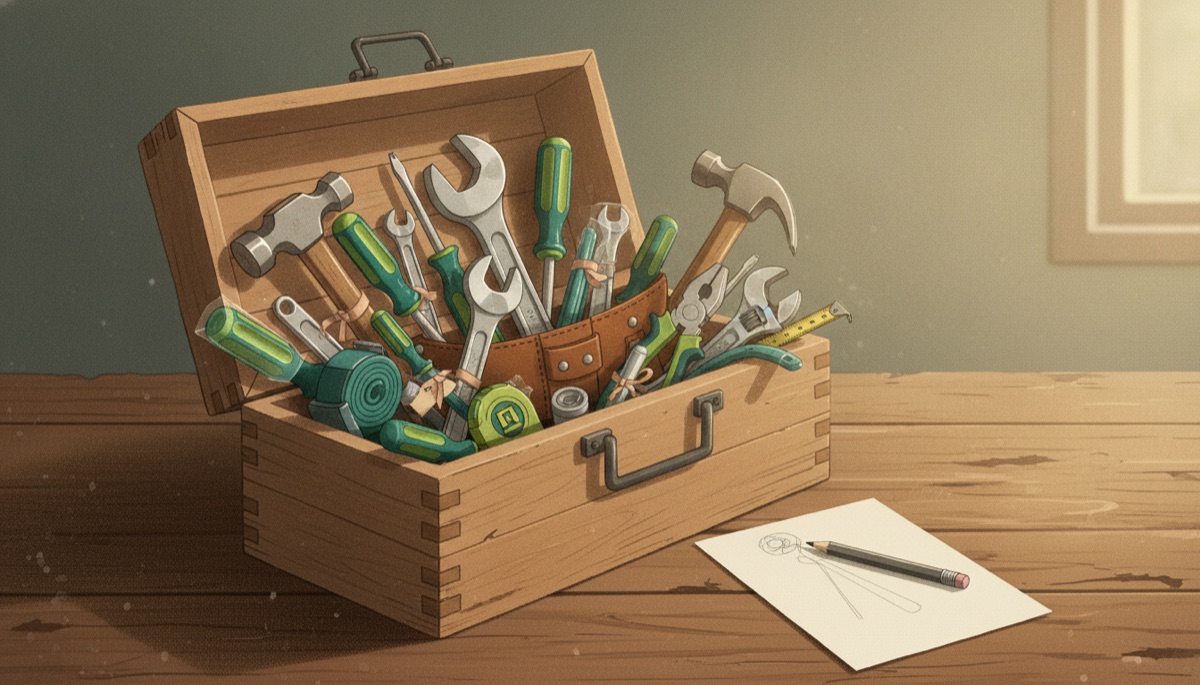
This pattern has a name: the toolbox fallacy. It is the belief that the thing standing between you and the work is a missing tool, when the thing actually standing there is the work itself. The toolbox fallacy is sneaky because preparing feels productive. You are researching, comparing, buying, configuring. Every step looks like progress. None of it is the task.
This article covers where the idea comes from, why it is so convincing, how to tell useful preparation from the fallacy, and a simple way to start with the tools you already own.
What the Toolbox Fallacy Actually Is
The toolbox fallacy is the assumption that you cannot begin, or cannot do good work, until you have the right equipment, software, knowledge or conditions. The term is internet-native rather than academic. It spread through online writing and video essays about creativity, usually with the same example: someone who wants to get fit and spends weeks choosing a gym, a program and a wardrobe instead of doing push-ups on the floor tonight.
The word "fallacy" is doing real work here. It is not that tools are useless. Good tools matter, eventually. The error is in the order. You treat the toolbox as a precondition for starting, when for most people the only thing that tells you which tools you need is having started.
A beginner photographer does not know whether they need a faster lens or a wider one. They find out after a few hundred shots with the phone in their pocket. A new writer does not know whether they want an outliner or a blank page. They find out after a few thousand words in whatever is already open.
Why It Feels So Convincing
If the toolbox fallacy were obviously silly, nobody would fall for it. It works because it borrows the feeling of progress from three real things.
Preparation is part of real work. Professionals do care about their tools. Chefs keep their knives sharp. Developers tune their editors. So when you spend an evening comparing tools, it looks like what serious people do. The difference is that professionals tune tools they are already using daily. You are choosing tools for a habit that does not exist yet.
Buying and setting up gives a small reward right now. Starting a hard task gives you discomfort now and a reward later. Ordering the new notebook gives you a little hit of anticipation today. Your brain is not stupid for preferring the second. It is just optimizing for the wrong clock.
Talking about a goal can feel like doing it. Psychologist Peter Gollwitzer and colleagues ran a set of studies, published in 2009, on what happens when people announce identity goals ("I want to become a lawyer", "I am going to be a writer"). People whose intentions were noticed by others later put in less effort than people who kept them private. The announcement seemed to give a partial sense of already being that person. Shopping for the tools of an identity can work the same way: owning the running shoes delivers a slice of "I am a runner" before a single kilometre.
Put those together and you get a loop. The task feels heavy, the tool hunt feels light and productive, and every finished setup step quietly lowers the urgency of the real thing.
The Toolbox Fallacy and ADHD
The toolbox fallacy hits harder when starting is already the hard part. If you live with ADHD, you probably know the wall between deciding to do a task and actually beginning it. We covered that wall in detail in our guide to ADHD activation and task initiation.
Tool research is a perfect way around that wall without ever going through it. It is novel, it has endless depth, every review links to three more reviews, and it delivers the steady trickle of interest an under-stimulated brain is looking for. It is also how a lot of ADHD hobby hopping begins: the research and buying phase is the most exciting part of a new interest, and the gear piles up long before the skill does.
Productivity apps are the classic version. Many people with ADHD have tried a dozen planners, task managers and note systems, each one set up beautifully over a weekend and abandoned within a month. The setup was the fun part. The daily use, which is where any system actually helps, never got a fair trial.
Useful Preparation vs the Toolbox Fallacy
Not all preparation is avoidance. Some tasks genuinely cannot start without a tool: you cannot practice the cello without a cello. So how do you tell the difference? A few honest questions help.
Could I do a rough version of this right now with what I have? If yes, the tool is an upgrade, not a precondition. A rough version of most goals is available today: push-ups instead of a gym, phone camera instead of a DSLR, a plain text file instead of the perfect writing app, a paper list instead of a task manager.
Have I used my current tool enough to know what it lacks? If you can name a specific limit you hit repeatedly ("my phone camera cannot handle indoor sports, every shot blurs"), you have earned the upgrade. If your reason is general ("a better app would help me be more organized"), that is the fallacy talking.
Is this the first, second or fifth time I have switched? One switch after real use is learning. A pattern of switching every few weeks is a sign the tool was never the problem.
Does the research have an end date? Useful preparation has a stopping point. The fallacy expands to fill whatever time you give it.
How to Break Out of the Toolbox Fallacy
1. Do the worst possible version first
Set a timer for ten minutes and do the task with the crudest tools available. Write the outline in your email drafts. Run around the block in the shoes you own. Sketch the app on paper. The goal is not quality. The goal is to turn "I am about to start" into "I have started", which is a different mental state and a much easier one to continue from. Our list of tactics for how to start a task with ADHD has more ways to make that first step tiny.
2. Make the tool earn its place
Use a simple rule: you can buy or switch to a new tool only after a set amount of real use with the current one. For example, two weeks of daily practice, or ten finished sessions. If you are still doing the thing after that, you will know exactly what to buy, and you will probably spend less. If you stopped, you just saved yourself the money and the guilt of gear on a shelf.
3. Cap the research
Give tool research a box on the calendar, say 30 minutes, and decide at the end of it, even if the decision is "the free option is fine". Comparing endless options is a known drain. Each extra choice adds a little decision fatigue, and past a point, more options make people less likely to pick anything at all.
4. Write an if-then plan for the tool hunt itself
The urge to research usually shows up at the exact moment you sit down to work. Plan for it in advance: "If I catch myself opening a review site when I meant to write, then I will write one sentence first and add the tool question to a list for Friday." This is an if-then plan, one of the best-studied ways to close the gap between intention and action. It works because it decides your response before the temptation arrives.
5. Keep a "later, maybe" list for tools
You do not have to kill the curiosity. Just park it. Every time you think "I should really get a better X", write it on one list and move on. Review the list once a week. Most items will look unnecessary by then. The few that survive, and that match a limit you have actually hit, are the ones worth buying.
6. Judge your system by use, not by setup
Whatever planning tool you use, the only test that matters is whether it is open and helping you on an ordinary Tuesday. A messy list you check every day beats a beautiful dashboard you visit once a month. If you notice you are about to rebuild your system again, ask whether the last version failed, or whether you simply stopped using it.
Where the Toolbox Fallacy Connects to Other Planning Traps
The toolbox fallacy has a close cousin in the planning fallacy: both are optimism about the future. The planning fallacy says "this will take less time than it will". The toolbox fallacy says "once I have the right setup, this will be easy". Both push the honest, uncomfortable part of the work into an imagined later where conditions are better.
The fix for both is similar too. Look at what actually happened the last few times. How many tools have you set up for this goal already? Did the last one change anything? That outside view is usually enough to puncture the hope that the next purchase will be different.
A Note on Productivity Apps (Including Ours)
It would be strange to write this article without admitting the obvious: Habidu is a tool, and a person caught in the toolbox fallacy could download it and spend an evening setting it up instead of doing their task.
So here is the honest advice. No app does your work. A good planning tool earns its place by reducing friction on days you already intend to work, by reminding you, breaking things into steps, and following up when you drift. If you try any tool, give it two ordinary weeks before judging it, and judge it by whether you did more of the actual task, not by how good the setup looked.
FAQ
What is the toolbox fallacy in simple terms?
It is the belief that you need the perfect tools, gear or setup before you can start something. In practice, the missing tool is rarely what is stopping you, and you usually only learn which tools you need after you have started with what you have.
Is the toolbox fallacy a form of procrastination?
Often, yes. It is a productive-looking kind of procrastination, because researching and buying tools feels like progress toward the goal. The test is whether you could do a rough version of the task right now without the new tool.
Where does the term toolbox fallacy come from?
It is an informal, internet-born term rather than a concept from academic psychology. It became popular through online essays and videos about creativity and self-improvement. The ideas behind it, such as preparation substituting for action, do have research support.
How is the toolbox fallacy different from the planning fallacy?
The planning fallacy is underestimating how long a task will take. The toolbox fallacy is overestimating how much the right tools will help, and treating them as a precondition for starting. Both delay the real work by betting on a better future.
When is buying a new tool actually worth it?
When you have used your current tool regularly and can name a specific limit you keep hitting. If you can only describe the benefit in general terms, such as "it would make me more organized", wait and keep using what you have.
Does the toolbox fallacy affect people with ADHD more?
It can. Tool research is novel and rewarding, which makes it an easy way around the difficulty of starting a task, and it often feeds into hobby hopping. The same fixes apply: start with the crude version, cap research time, and let tools earn their place through use.
Ready to plan your day the ADHD-friendly way?
Habidu is your AI daily coach - gentle nudges, tiny steps, zero shame spirals. Download it free:

